Ganpati
Lalbaugcha Raja
📍 Lalbaug, Mumbai · Est. 1934
Mumbai's most visited Ganpati — the wish-fulfilling Navasacha Ganpati. Idol sculpted by the Kambli family since 1935.
Ganpati Wala
गणपति बाप्पा मोरया! 🙏
गणपति के रंग, बाप्पा की भक्ति, आरती, संगीत और उन यादों का एक छोटा सा डिजिटल सफ़र जो हर साल दिल के करीब आता है।
Celebrate Ganpati with devotional songs, aarti, memories, festival vibes and the spirit of Bappa.
Ganpati Aarti & Devotional Songs
Loading…
loading aarti…
—·गणपति बाप्पा मोरया
made with ♥ by WalaVerse
Streaming devotionals via YouTube's official player — audio only, no downloads.
A Festival of Memories
गणपति — जिसे हम प्यार से बाप्पा कहते हैं — भारत के सबसे प्रिय और सबसे बड़े त्योहारों में से एक है। हर साल अगस्त-सितंबर में गणेश चतुर्थी आती है और पूरा देश उत्सव के रंग में रंग जाता है। “गणपति बाप्पा मोरया!” — यह नारा हर गली, हर मोहल्ले, हर शहर में गूँजता है।
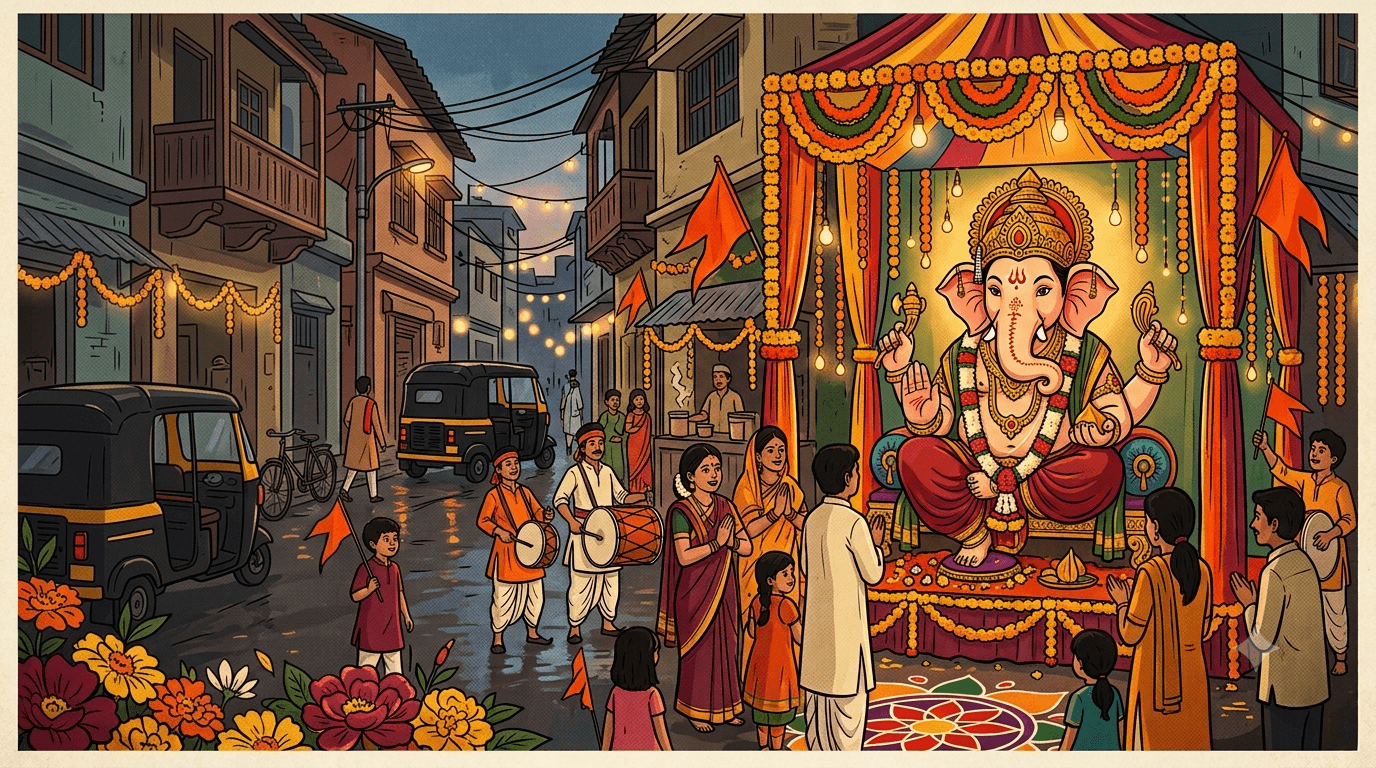
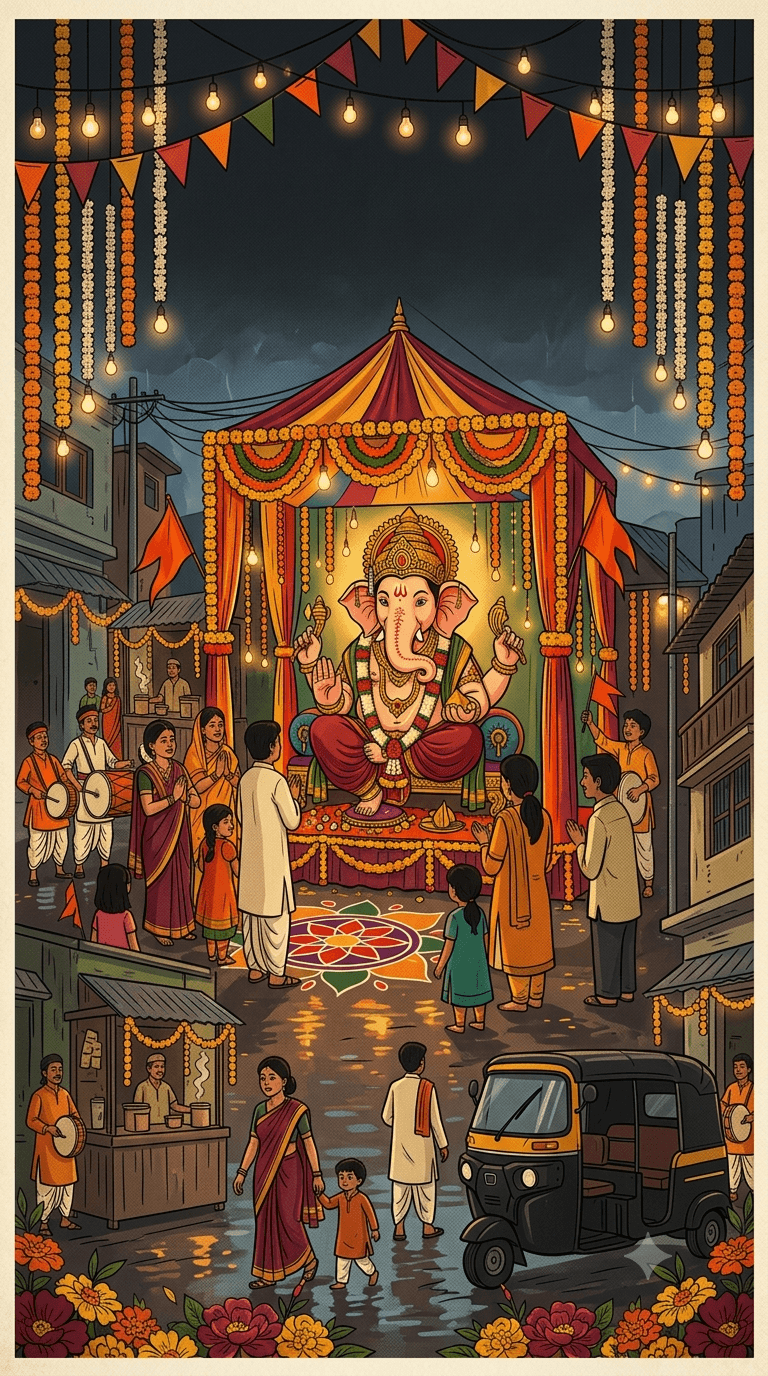
मुंबई में गणपति का अलग ही रूप है। लालबाग का राजा, गणेशकुटी, इंदूर का गणपति — हर जगह अपनी अलग पहचान। सड़कों पर मंडप सजते हैं, ढोल-ताशा बजते हैं, और लोग दर्शन के लिए घंटों लाइन में खड़े रहते हैं। बारिश की बूँदों में भी उत्सव कम नहीं होता।
बाप्पा के दरबार में मोदक का नैवेद्य, फूलों की माला, और आरती की घंटी — यह सब मिलकर एक ऐसा माहौल बनाते हैं जो दिल को छू जाता है। परिवार एक साथ बैठता है, बच्चे बाप्पा के गाने गाते हैं, और बुजुर्ग कथा सुनाते हैं। दोस्त मिलकर मंडप सजाते हैं और शाम को आरती में शामिल होते हैं।
और फिर आता है विसर्जन का दिन — जब बाप्पा को विदाई देते हुए आँखें भीग जाती हैं। “गणपति बाप्पा मोरया, अगले बरस तू जल्दी आ।” यह विदाई अंतिम नहीं, बल्कि एक नए आगमन का वादा है। गणपति का त्योहार सिर्फ एक उत्सव नहीं, यह भक्ति, प्रेम, परिवार और यादों का मिलाप है।
Ganpati Bappa & Ganesh Chaturthi
Ganpati — lovingly called Bappa — is Lord Ganesha, the remover of obstacles and the god of wisdom, new beginnings and prosperity. Ganesh Chaturthi (also known as Ganesh Utsav, Ganeshotsav or Ganpati Utsav) is the festival that celebrates his birth. For ten days, homes, societies and neighbourhood pandals welcome the elephant-headed deity with prayers, aarti, modak and music before bidding him farewell at visarjan.
In 2026, Ganesh Chaturthi falls on Monday, 14 September 2026. The festival begins with Ganpati sthapana during the midday muhurat and runs until Anant Chaturdashi on Friday, 25 September 2026, when Mumbai holds its grand visarjan processions.
While Maharashtra — and Mumbai above all — celebrates with unmatched grandeur, Ganesh Chaturthi is observed across India: as Ganeshotsav in Maharashtra, Vinayaka Chaturthi in the south, and Ganesh festival among the global diaspora. Wherever Bappa arrives, the spirit is the same — devotion, togetherness and the chant of “Ganpati Bappa Morya!”
Ganpati Songs, Aarti & Devotional Music
Music is the heartbeat of Ganeshotsav. The most loved Ganpati song is the Marathi aarti Sukhkarta Dukhharta (“harbinger of happiness, remover of sorrow”), traditionally attributed to Saint Samarth Ramdas. Its refrain “Jai Dev Jai Dev Jai Mangal Murti” rings through nearly every Maharashtrian home during the festival, as the aarti lamp is waved in slow circles before Bappa.
Around it, the festival swells with Ganpati Bappa Morya chants, dhol-tasha drum beats, Ganesh bhajans, mantras and stotras. Whether you want a steady Ganpati aarti for daily puja or bhajans for the mandap atmosphere, the built-in Ganpati Wala player streams devotional songs directly through YouTube's official player — audio only, no downloads.
🙏 गणपति आरती सुनेंMoments with Bappa
Ganpati Shayari
Bappa
सिर पर तुम्हारा टीका, दिल में तुम्हारा नाम, गणपति बाप्पा मोरया, हर पल है तुम्हारा काम।
1 / 45
Ganpati Wishes
From heartfelt Hindi and Marathi shubhechha (शुभेच्छा) to warm English greetings, Ganpati wishes carry the festival's spirit to family, friends and neighbours. Short wishes and quotes are perfect for WhatsApp status, Instagram captions and festival messages.
🙏 गणपति बाप्पा मोरया! बाप्पा आपके जीवन में खुशियाँ लाएँ।
Happy Ganesh Chaturthi! May Lord Ganesha bless you with wisdom and prosperity.
🌺 गणपति चतुर्थी की हार्दिक शुभकामनाएँ! बाप्पा आप सबका भला करें।
🙏 May Ganpati Bappa remove all obstacles from your path. Ganpati Bappa Morya!
🍬 मोदक की मिठास हो, बाप्पा का आशीर्वाद हो। गणपति उत्सव की शुभकामनाएँ!
🚩 Ganpati Bappa Morya! Wishing you a festival filled with devotion, music and togetherness.
🏮 बाप्पा के दरबार में आपका स्वागत है। गणपति बाप्पा मोरया!
🪷 May the blessings of Lord Ganesha bring peace, joy and success to your family. Happy Ganesh Chaturthi!
🌼 गणपती बाप्पा मोरया! आपणा सर्वांना गणेशोत्सवाच्या हार्दिक शुभेच्छा!
✨ May every new beginning you take this Ganesh Utsav be blessed by Ganpati Bappa. Ganpati Bappa Morya!
🇮🇳 Happy Ganesh Chaturthi 2026! May the festival of Ganeshotsav bring joy, peace and prosperity to your home.
🎶 गणपति बाप्पा मोरया... बाप्पा की भक्ति, संगीत और त्योहार की खुशियाँ आप सबके साथ रहें।
Ganpati Idol & Home Decoration
Bringing Bappa home begins with choosing the right murti and setting up a mandap worthy of the remover of obstacles. A growing number of families prefer eco-friendly Ganpati idols made of natural clay (śaḍū māṭī) that dissolve easily in water, avoiding the Plaster-of-Paris idols that harm rivers and lakes during visarjan. Across Mumbai, mandals now host eco Ganesh celebrations with clay idols, natural colours and small water tanks for immersion.
A simple home mandap — a decorated cloth base, flowers, diyas and a small rangoli — is all Bappa needs to feel at home.
The Heart of Ganeshotsav
Mumbai is the undisputed capital of Ganeshotsav in India. From the first public Ganpati celebration in 1893 at Keshavji Naik Chawl in Girgaon, the festival has grown into one of the largest public celebrations in the world. Every monsoon, the city transforms — streets fill with dhol-tasha, mandaps rise at every corner, and lakhs of devotees queue for hours at famous Ganpati pandals.
The tradition owes much to Lokmanya Bal Gangadhar Tilak, who championed the Sarvajanik (public) Ganeshotsav as a platform for community gathering and national unity. From that vision, Mumbai developed a unique culture of neighborhood mandals — each with its own history, idol style, and community spirit. The city hosts everything from the wish-fulfilling Lalbaugcha Raja to small society Ganpatis in residential buildings.
The Most Celebrated Ganpati Pandals
Ganpati
📍 Lalbaug, Mumbai · Est. 1934
Mumbai's most visited Ganpati — the wish-fulfilling Navasacha Ganpati. Idol sculpted by the Kambli family since 1935.
Ganpati
📍 Ganesh Galli, Lalbaug, Mumbai · Est. 1928
The 'King of Mumbai' — known for the tallest Ganesh idol tradition and world-record gold necklace.
Ganpati
📍 Girgaon, Mumbai · Est. 1893
Mumbai's very first Sarvajanik Ganeshotsav. The 2-foot clay idol has been carried on a simple palkhi for over 130 years.
Ganpati
📍 King's Circle, Mumbai · Est. 1955
Mumbai's richest Ganpati — 66 kg of gold and 336 kg of silver adorn the idol. Insured for Rs 474 crore.
Ganpati
📍 Khetwadi, Mumbai · Est. 1959
Maker of the tallest Ganesh idols — a record 40-foot Parshuram Avatar in 2000.
Oldest Ganpati Mandals in Mumbai
The tradition of public Ganpati celebrations in Mumbai — known as Sarvajanik Ganeshotsav — began in 1893 at Keshavji Naik Chawl in Girgaon. Two of Lokmanya Tilak's close associates, Rao Bahadur Limaye and Godse Shastri, organized the first community celebration in response to Tilak's call for public unity.
Lokmanya Bal Gangadhar Tilak championed the transformation of Ganesh Chaturthi from a private household celebration into a public community festival. His vision went beyond religion — he used the festival as a platform for nationalist mobilization against British rule, bypassing colonial restrictions on political gatherings. In 1894, Tilak introduced large public Ganesha images in decorated mandaps, street-level fundraising, and a unified immersion ceremony on the 10th day.
In 1901, Tilak personally visited the Keshavji Naik Chawl pandal — becoming the first politician to do so. From that one chawl in Girgaon, the tradition spread across Mumbai: mill workers in Lalbaug and Parel formed their own mandals, chawl communities in Dadar and Byculla joined in, and neighborhoods across the city established their own Ganpati celebrations. Cultural programs, music, dance, and public gatherings became an integral part of the festival.
Today, Mumbai hosts thousands of Ganpati mandals — from grand, internationally famous celebrations to intimate society and neighborhood observances. The spirit of community participation that Tilak envisioned in 1893 continues to define the festival across every locality in the city.
Keshavji Naik Chawl Ganpati
Girgaon · Est. 1893
133 years of Ganpati tradition
Chinchpokli Cha Chintamani
Chinchpokli · Est. 1920
106 years of Ganpati tradition
Mumbaicha Raja
Ganesh Galli, Lalbaug · Est. 1928
98 years of Ganpati tradition
Girgaon Cha Raja
Girgaon · Est. 1928
98 years of Ganpati tradition
Lalbaugcha Raja
Lalbaug Market · Est. 1934
92 years of Ganpati tradition
Rangari Badak Chawl Ganpati
Kalachowki · Est. 1938
88 years of Ganpati tradition
Explore Ganpati Pandals Across Mumbai
South Mumbai — from Girgaon to Fort — is where Mumbai's public Ganpati tradition began. The oldest mandals in the city are concentrated here, many born in the chawls and mill neighborhoods of the late 19th and early 20th centuries.
Keshavji Naik Chawl Ganpati
Girgaon · Est. 1893(133 years of Ganpati tradition)
Mumbai's first Sarvajanik Ganeshotsav — the birthplace of the public Ganpati tradition.
Girgaon Cha Raja
Girgaon · Est. 1928(98 years of Ganpati tradition)
One of Mumbai's oldest mandals AND a pioneer of eco-friendly Ganeshotsav — clay idol since inception.
Tulsiwadi Cha Maharaja
Tardeo · Est. 1939(87 years of Ganpati tradition)
Extremely creative and elaborate idol designs — once adorned with 300,000 artificial diamonds.
Khetwadi Ganraj
Khetwadi · Est. 1959(67 years of Ganpati tradition)
Mumbai's maker of the tallest Ganesh idols — a record-breaking 40-foot Parshuram Avatar in 2000.
Icchapurti Ganesh
Fort · Est. 1956(70 years of Ganpati tradition)
Elevated 12-foot pandal with vehicles passing underneath — one of the largest pandals in Mumbai.
The Lalbaug-Parel belt is the heartland of Mumbai's most iconic Ganpati mandals. The textile mills that once drove the city's economy also gave rise to some of its most celebrated community festivals.
Chinchpokli Cha Chintamani
Chinchpokli · Est. 1920(106 years of Ganpati tradition)
"Chintamani" means the one who takes away all worries — the first Sarvajanik mandal in the Lalbaug-Parel belt.
Mumbaicha Raja
Ganesh Galli, Lalbaug · Est. 1928(98 years of Ganpati tradition)
The title 'Mumbai Cha Raja' was officially adopted in 2004. Holds world records for tallest Ganesh idol tradition and largest gold necklace.
Lalbaugcha Raja
Lalbaug Market · Est. 1934(92 years of Ganpati tradition)
Mumbai's most popular and most visited Ganpati — the wish-fulfilling Ganpati that draws lakhs of devotees every year.
Rangari Badak Chawl Ganpati
Kalachowki · Est. 1938(88 years of Ganpati tradition)
The unique 'Ladka Lambodar' (Baby/Young Ganesha) depiction that has become famous across Maharashtra.
Parel Cha Raja
Parel · Est. 1947(79 years of Ganpati tradition)
The idol is always in a standing position — a unique feature requiring a foldable crown to pass under the Lalbaug Bridge.
Tejukayacha Raja
Lalbaug
Pioneer of eco-friendly large-scale idols — 22-foot idol made entirely from recycled newspapers and clay since 2019.
The western suburbs have their own Ganpati traditions, shaped by workers who migrated from the Lalbaug-Parel mills. Andhericha Raja stands as the most prominent pandal in this part of the city.
Andhericha Raja
Andheri West · Est. 1966(60 years of Ganpati tradition)
One of the oldest and most popular Ganpati pandals in Mumbai's western suburbs — visarjan on Sankashti Chaturthi.
Eastern Mumbai's Ganpati celebrations include vibrant pandals in Chembur and Tilak Nagar, known for their creative themes and community spirit.
Sahyadri Krida Mandal
Tilak Nagar, Chembur · Est. 1977(49 years of Ganpati tradition)
Grand decoration sets and creative themes — replicas of Red Fort, Shaniwar Wada, Mysore Palace, and Akshardham Temple.
The suburbs host mandals that blend tradition with spectacle. GSB Seva Mandal at King's Circle is among the richest Ganpati celebrations in the country.
GSB Seva Mandal
King's Circle, Matunga · Est. 1955(71 years of Ganpati tradition)
Mumbai's richest Ganpati mandal — idol adorned with 66 kg of gold and 336 kg of silver.
Searchable Guide to Ganpati Mandals Across Mumbai
Showing 14 of 14 mandals
Ganpati
Keshavji Naik Chawl Ganpati
📍 Girgaon, Mumbai
Established: 1893· 133 years of Ganpati tradition
Mumbai's first Sarvajanik Ganeshotsav — the birthplace of the public Ganpati tradition.
Ganpati
Chinchpokli Cha Chintamani
📍 Chinchpokli, Mumbai
Established: 1920· 106 years of Ganpati tradition
"Chintamani" means the one who takes away all worries — the first Sarvajanik mandal in the Lalbaug-Parel belt.
Ganpati
Mumbaicha Raja
📍 Ganesh Galli, Lalbaug, Mumbai
Established: 1928· 98 years of Ganpati tradition
The title 'Mumbai Cha Raja' was officially adopted in 2004. Holds world records for tallest Ganesh idol tradition and largest gold necklace.
Ganpati
Lalbaugcha Raja
📍 Lalbaug Market, Mumbai
Established: 1934· 92 years of Ganpati tradition
Mumbai's most popular and most visited Ganpati — the wish-fulfilling Ganpati that draws lakhs of devotees every year.
Ganpati
Girgaon Cha Raja
📍 Girgaon, Mumbai
Established: 1928· 98 years of Ganpati tradition
One of Mumbai's oldest mandals AND a pioneer of eco-friendly Ganeshotsav — clay idol since inception.
Ganpati
Tulsiwadi Cha Maharaja
📍 Tardeo, Mumbai
Established: 1939· 87 years of Ganpati tradition
Extremely creative and elaborate idol designs — once adorned with 300,000 artificial diamonds.
Ganpati
Rangari Badak Chawl Ganpati
📍 Kalachowki, Mumbai
Established: 1938· 88 years of Ganpati tradition
The unique 'Ladka Lambodar' (Baby/Young Ganesha) depiction that has become famous across Maharashtra.
Ganpati
Parel Cha Raja
📍 Parel, Mumbai
Established: 1947· 79 years of Ganpati tradition
The idol is always in a standing position — a unique feature requiring a foldable crown to pass under the Lalbaug Bridge.
Ganpati
GSB Seva Mandal
📍 King's Circle, Matunga, Mumbai
Established: 1955· 71 years of Ganpati tradition
Mumbai's richest Ganpati mandal — idol adorned with 66 kg of gold and 336 kg of silver.
Ganpati
Khetwadi Ganraj
📍 Khetwadi, Mumbai
Established: 1959· 67 years of Ganpati tradition
Mumbai's maker of the tallest Ganesh idols — a record-breaking 40-foot Parshuram Avatar in 2000.
Ganpati
Icchapurti Ganesh
📍 Fort, Mumbai
Established: 1956· 70 years of Ganpati tradition
Elevated 12-foot pandal with vehicles passing underneath — one of the largest pandals in Mumbai.
Ganpati
Andhericha Raja
📍 Andheri West, Mumbai
Established: 1966· 60 years of Ganpati tradition
One of the oldest and most popular Ganpati pandals in Mumbai's western suburbs — visarjan on Sankashti Chaturthi.
Ganpati
Sahyadri Krida Mandal
📍 Tilak Nagar, Chembur, Mumbai
Established: 1977· 49 years of Ganpati tradition
Grand decoration sets and creative themes — replicas of Red Fort, Shaniwar Wada, Mysore Palace, and Akshardham Temple.
Ganpati
Tejukayacha Raja
📍 Lalbaug, Mumbai
Establishment year not reliably confirmed.
Pioneer of eco-friendly large-scale idols — 22-foot idol made entirely from recycled newspapers and clay since 2019.
Every Ganpati Has Its Own Story
Mumbai has thousands of Ganpati mandals — from grand celebrations to small society pandals. The best Ganpati experience is often the one closest to you.
Visiting Ganpati Pandals with Respect
Darshan — the act of seeing and being seen by the deity — is the heart of the Ganpati festival experience in Mumbai. Every year, lakhs of devotees visit famous Ganpati mandals across the city to seek blessings, admire the elaborate idol decorations, and participate in the aarti.
Always check official mandal sources or local news for the most current darshan information before visiting. Timings and crowd conditions change each year.
Routes for Visiting Ganpati Pandals Across the City
साउथ मुंबई गणपति रूट
Girgaon → Khetwadi → Opera House → Fort
💡 Start early morning to cover all five. Girgaon's narrow lanes are best explored on foot.
लालबाग / परळ गणपति रूट
Lalbaug → Chinchpokli → Parel → Kalachowki
💡 This is the densest cluster of famous mandals in Mumbai. The three Lalbaug mandals are within walking distance of each other.
गिरगांव गणपति रूट
Charni Road → Girgaon → Walkeshwar
💡 Girgaon's Ganpati tradition goes back to 1893. Walk through the old chawl lanes to experience the original Sarvajanik Ganeshotsav atmosphere.
सेंट्रल मुंबई गणपति रूट
Parel → Matunga → King's Circle
💡 GSB Seva Mandal runs for only 5 days — plan your visit accordingly. King's Circle is well-connected by rail.
वेस्टर्न सबर्ब्स गणपति रूट
Andheri → Versova
💡 Andhericha Raja's visarjan is unique — it happens on Sankashti Chaturthi, 5 days after Anant Chaturdashi. The procession to Versova Beach starts at 5 PM.
ईस्टर्न सबर्ब्स गणपति रूट
Chembur → Tilak Nagar
💡 Sahyadri Krida Mandal is known for its grand themed pandals — replicas of historic landmarks. Tilak Nagar station is on the Harbour Line.
The Grand Immersion Procession
Anant Chaturdashi — the 10th and final day of Ganeshotsav — is when Mumbai bids an emotional farewell to Ganpati Bappa. The visarjan (immersion) procession is one of the largest public gatherings in the world, with lakhs of devotees filling the streets from early morning until well past midnight.
In recent years, Mumbai has moved toward more environmentally responsible immersion practices. Many mandals now use clay (shadu mati) idols instead of Plaster of Paris. Girgaon Cha Raja has used clay since 1928. Tejukayacha Raja creates its 22-foot idol from recycled newspapers. The city has also set up over 200 artificial immersion ponds across wards to protect marine ecosystems.
Check official mandal announcements and local news for current-year visarjan timings, route details, and any civic advisories.
“गणपति बाप्पा मोरया, पुढल्या वर्षी लवकर या!”
— Ganpati Bappa Morya, come again early next year!
Ganesh Chaturthi 2026 — Festival Dates & Information
Ganesh Chaturthi 2026 falls on Monday, 14 September 2026. Ganpati Bappa arrives home on this day with the sthapana (idol installation) ritual and departs with the grand visarjan on Anant Chaturdashi, Friday, 25 September 2026.
Families and mandals choose how long Bappa stays. The main 10-day immersion takes place on Anant Chaturdashi (Friday, 25 September 2026), the day of Mumbai's grand visarjan processions.
Dates based on the panchang for Mumbai in 2026. Check official mandal announcements, the BMC and local news for current-year darshan timings, mandal themes and visarjan routes.
Frequently Asked Questions
Ganesh Chaturthi, also known as Ganpati Chaturthi or Ganeshotsav, is a Hindu festival celebrating the birth of Lord Ganesha (Ganpati). It falls on the Chaturthi Tithi of Shukla Paksha in the Hindu month of Bhadrapada (August–September). The festival lasts 10 days, beginning with Ganpati Sthapana (idol installation) and ending with Ganpati Visarjan on Anant Chaturdashi. It is especially grand in Maharashtra, where public Ganeshotsav celebrations bring entire neighbourhoods together.
Ganesh Chaturthi in 2026 falls on Monday, 14 September. The Chaturthi Tithi begins at approximately 7:06 AM on 14 September and ends at approximately 7:44 AM on 15 September. The Mumbai Madhyahna (midday) puja muhurat is approximately 11:20 AM to 1:48 PM on 14 September. The festival concludes with Anant Chaturdashi (main Ganpati Visarjan) on Friday, 25 September 2026. Confirm exact timings with your local panchang.
"Ganpati Bappa Morya" is a popular devotional chant used during the Ganpati festival. "Bappa" is an affectionate term meaning father or lord, and "Morya" is believed to refer to a devotee of Ganesha. Together, the phrase is a joyful call of celebration and devotion, used in processions, aarti, and during visarjan.
Ganpati Aarti is a devotional hymn sung in praise of Lord Ganesha during worship. The most popular aarti is "Sukhkarta Dukhharta" in Marathi, traditionally attributed to Saint Samarth Ramdas and composed in raga Jogiya. Aarti is performed with a lit lamp (diya) moved in circular motions before the Ganpati idol, accompanied by bells, drums, and devotional singing.
Popular Ganpati songs include "Sukhkarta Dukhharta" (the Marathi aarti by Samarth Ramdas), "Jai Dev Jai Dev Jai Mangal Murti" (chorus refrain from Sukhkarta), Ganpati Bappa Morya chants, and bhajans such as "Morya Re Bappa." Devotional music playlists feature aarti collections, Ganesh mantras, stotras, and bhakti songs played throughout the 10-day Ganeshotsav festival.
Ganpati Sthapana is the ritual of installing a Ganpati (Ganesha) idol at home or in a public pandal, marking the beginning of Ganesh Chaturthi celebrations. The idol is placed in a decorated area, invoked with mantras, and worshipped with flowers, incense, diyas, durva grass and modak. The most auspicious time is the Madhyahna (midday) muhurat on the Chaturthi Tithi.
Ganpati Visarjan is the ritual of immersing Lord Ganesha's idol in a body of water at the end of the Ganesh Chaturthi festival. It symbolises the cyclical nature of creation and dissolution. The idol is carried in a grand procession with music, dancing, and chants of "Ganpati Bappa Morya, agle baras tu jaldi aa." It takes place on Anant Chaturdashi, the 10th day of the festival.
Ganpati Chaturthi became a large-scale public celebration in Mumbai thanks to Lokmanya Tilak, who in 1893 transformed it from a private family worship into a community festival. This was intended to bring people together across caste and class divides. Today, Mumbai is famous for its grand Ganpati celebrations, massive pandals, and the world's largest visarjan procession.
The Ganpati festival celebrates the birth of Lord Ganesha, the remover of obstacles. It is a time for prayer, community gathering, and cultural celebration. Devotees install Ganpati idols at home and in public pandals, perform daily aarti, offer modaks, and seek blessings for new beginnings, wisdom, and prosperity. The festival strengthens community bonds and celebrates Indian cultural heritage.
Common Ganpati traditions include bringing home or installing a Ganpati idol, performing daily aarti with devotional songs, offering modaks and other sweets to the deity, decorating the mandap with flowers and lights, participating in dhol-tasha processions, visiting pandals for darshan, and finally performing visarjan on the last day. Families and communities come together to celebrate with food, music, and prayer.
Common Ganpati wishes include: "Ganpati Bappa Morya!" — a joyful greeting, "Happy Ganesh Chaturthi" — wishing prosperity and new beginnings, "May Lord Ganesha bless you with wisdom and remove all obstacles," and heartfelt Hindi wishes like "बाप्पा आपके जीवन में खुशियाँ लाएँ।" These wishes are shared with family, friends, and loved ones during the festival.
Popular Ganpati decoration ideas include flower garlands and marigold strings, rangoli patterns at the mandap entrance, fairy lights and LED lighting, a backdrop (makhar) behind the idol, themed pandal decor with traditional or modern elements, banana or mango leaf torans, and eco-friendly decoration using natural materials. Simple home decoration can use a decorated cloth base, flowers, diyas, and a colourful rangoli.
Famous Ganpati mandals in Mumbai include Lalbaugcha Raja in Lalbaug (est. 1934), Mumbaicha Raja at Ganesh Galli (est. 1928), GSB Seva Mandal at King's Circle (Mumbai's richest Ganpati), Keshavji Naik Chawl in Girgaon (Mumbai's first Sarvajanik Ganeshotsav, est. 1893), Girgaon Cha Raja, Khetwadi Ganraj, and Andhericha Raja in Andheri West. Most are near rail stations on the Mumbai suburban network.
Ganpati darshan is the act of visiting a Ganpati mandal or pandal to seek blessings and view the Ganesha idol. In Mumbai, lakhs of devotees visit famous mandals such as Lalbaugcha Raja during the 10-day Ganeshotsav. Darshan queues at popular mandals can stretch several hours, especially during evenings and weekends. Each mandal typically offers Mukh Darshan (viewing the idol's face) and Charan Sparsh Darshan (close to the idol's feet).
Modak is a sweet dumpling considered Lord Ganesha's favourite prasad. Ukadiche modak (steamed modak) made from rice flour and stuffed with jaggery and coconut is the traditional offering during Ganesh Chaturthi puja. Twenty-one modaks are offered during Sthapana as a sign of devotion. During the festival, modak is distributed as prasad to family, friends and neighbours.
Ganpati Wala is a digital shrine and cultural archive dedicated to one of India's most transformative community traditions: the collective celebration of Ganesh Chaturthi. Born out of the historic Sarvajanik Ganeshotsav movement pioneered by Lokmanya Bal Gangadhar Tilak in Pune and Bombay in 1893, the festival turned private domestic prayer into an open, inclusive neighbourhood gathering where citizens from all walks of life broke bread, discussed civic welfare, and celebrated art together.
In modern India, the spirit of the local *mandal* (neighbourhood festival committee) represents grassroots community coordination at its finest. Weeks before Bhadrapada Shukla Chaturthi, young volunteers gather in alleyways to construct temporary bamboo and cloth pandals, paint thematic backdrops, string fairy lights across street intersections, and organize flower garlands, prasad kitchens, and medical camps. The neighbourhood becomes an extended family, united in service of Bappa.
Central to this celebration is its acoustic soul. From the rhythmic thunder of traditional dhol-tasha pathaks marching in synchronized choreography to the devotional resonance of the evening aarti—Saint Samarth Ramdas's immortal *Sukhkarta Dukhharta*—music is the pulse that gathers crowds and lifts spirits. Over the decades, as brass bands and public address loudspeaker systems joined the acoustic landscape, the music evolved, but the underlying devotion remained steadfast.
Ganpati Wala curates this living heritage for listeners everywhere. Whether you are far from home during the ten festive days, seeking a tranquil backdrop for morning prayer, or wanting to share the festive atmosphere with the next generation, this platform keeps the devotional frequencies flowing—clean, reverent, and commercial-free.
Keep Exploring
Deep dive into mandal logistics, acoustic histories, and the musical evolution of Ganeshotsav:
A 10-step handbook on permits, pandal fire safety, budgets, prasad, and eco-friendly visarjan.
Structuring a 10-day acoustic journey from morning aartis to celebratory dhol rhythms.
The acoustic evolution of street celebrations, dhol-tasha pathaks, and sound systems.
The linguistic and social dignity of India's trade custodians and neighbourhood anchors.
Ganpati Wala is part of WalaVerse, a family of retro tributes to India's everyday heroes and cultural moments. From the auto-rickshaw streets to the Ganpati mandap, each Wala keeps its own rhythm playing.